About
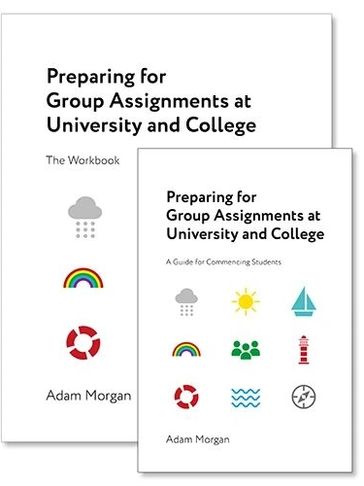
This guide and accompanying workbook help commencing university and college students prepare for their upcoming group assignment experiences.
The Guide
The guide provides commencing students with important preparatory information regarding their upcoming group assignments. Written in an informal conversational style, and using a sailing group as a case example, the guide is divided into two parts.
In the first part, some of your upcoming experiences are presented. These are:
· Group growth over time
· Setting norms
· Making collective decisions
· Behaving and responding cycles
· Reduction in behaviors
· Varying outputs
· Conflict
· Positive aspects
In the second part, several bigger picture issues and suggestions are presented. These are:
· Viewing group work as a growth opportunity
· Knowing where you need to grow
· Documenting your experiences and growth
· Starting positively
· Taking responsibility for your actions
· Embracing diversity
· Seeking support
After reading the guide, students will have a better understanding of what lies ahead with group assignments and how they can start preparing for them.
Guide available in paperback and e-book formats.
Paperback
ISBN: 978-0-6456794-2-7
Size: 6 x 9 inch
Length: 86 pages
E-book
ISBN: 978-0-6456794-4-1
The Workbook
The workbook helps commencing students think deeper about the topics and issues presented in the above-mentioned guide.
The workbook is divided into two main parts and mirrors the guide’s contents. In the first part, the upcoming experiences presented in the guide are re-visited. In the second part, some of the suggestions offered in the guide’s bigger picture section and re-covered. In both parts, students need to answer some prompting questions related to various topics and issues.
After completing this workbook, students will have given deeper consideration to the topics and issues presented in the guide and should be even more prepared for their upcoming group assignments. Reading about the challenges and opportunities associated with group assignments is one thing. Giving targeted thought to them is the next level up.
Important! This workbook builds on the topics and issues presented in the above-mentioned guide. It is important that the guide is read before completing this workbook.
As this is a workbook, it is only available in a paperback formats.
Paperback
ISBN: 978-0-6456794-3-4
Size: US letter
Length: 24 pages
More
Most university and college students participate in group assignments throughout their course of study. Such assignments can be very rewarding. However, they can also be very challenging at times. One option is to let students discover this out for themselves. Another is to help them prepare for what might lie ahead. This guide and accompanying workbook take the latter approach. They work on the assumption that it is better to be honest and realistic about the situations students might find themselves in; not to worry them, but to better prepare them for group assignments.
After reading the guide commencing students should have a better understanding of group assignments. They should have a better understanding of their purpose and their internal dynamics. Students will also be introduced to the bigger picture of group work in higher education and have a better understanding how they can prepare for their upcoming group assignments. After completing the accompanying workbook, students will have given deeper consideration to the topics and issues presented in the guide. Reading about the challenges and opportunities associated with group work is one thing. Giving targeted thought to them is the next level.
Ideally, students should read the guide and complete the workbook before commencing their studies. Following this, they should then be given the opportunity to discuss their upcoming group assignments and workbook answers with other commencing students and institutional staff. The guide and workbook give commencing students important preparatory information to consider. It is crucial they are given the chance to raise any issues or concerns they have about group assignments and feel supported. These discussions might take place in an orientation session or in a first-year class.
A workbook completed to a satisfactory level provides evidence that a student has given consideration to the issues associated with their upcoming group assignments. Such considerations also serve as a record of the student’s thoughts and level of preparedness at the commencement of their studies. It makes an excellent early artifact that students can use in later years to reflect back upon (e.g., to look back on their identified collaborative strengths and weaknesses). Completed workbook entries could be also used as an early submission in a student’s e-portfolio.

Copyright © 2026 Adam Morgan - All Rights Reserved.